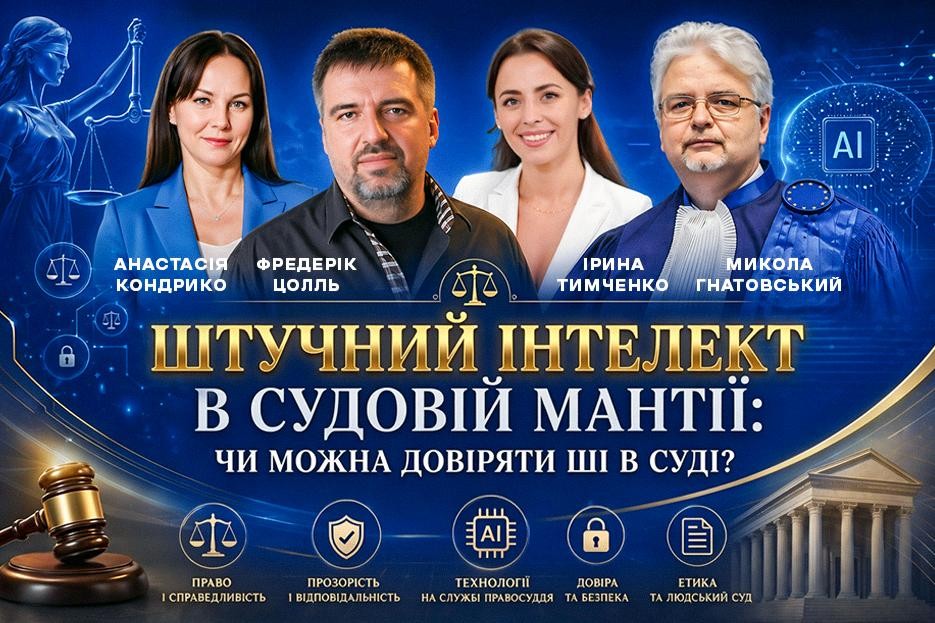
Artificial intelligence in the judge's robe: can AI be trusted in court?
Artificial intelligence is no longer a thing of the future – it is a reality of the present that influences the way we work, make decisions and interact with the world on a daily basis. From the automation of routine tasks to the creation of complex analytical models, new technologies are opening up unprecedented opportunities, but at the same time presenting society with a number of challenges. This was the focus of the final day of training for Supreme Court judges at the National School of Judges of Ukraine.
The director of Cyber Media Track, founder and chair of the public organisation ‘Synergy of Analysts of Ukraine’, member of the National Union of Journalists of Ukraine, cybercrime investigation expert for the OSCE Support Programme for Ukraine, PhD in Social Communications, and media, cyber, crypto and AI specialist Anastasiia Kondryko.
During her presentation, the speaker emphasised that artificial intelligence has already become an integral part of modern life. According to her, even those users who approach new technologies with a degree of caution interact with them in one way or another on a daily basis. The reasons for this are the desire to optimise, automate and speed up work processes.
Anastasiia Kondryko drew particular attention to the global scale of AI usage. In particular, she cited data showing that over a billion people worldwide regularly use just one model – ChatGPT – which demonstrates the rapid spread of the technology.
The lecture took place in an interactive format. Participants joined the discussion via online tools, answered questions and analysed key concepts related to artificial intelligence. In particular, the principles of how language models work, the concept of AI ‘hallucinations’, data processing mechanisms and the importance of correctly formulating prompts were examined.
The speaker emphasised that, alongside its advantages, artificial intelligence also carries significant risks. These include the potential to generate false information, threats to data privacy, and the use of technology in cybercrime. She warned against carelessly uploading personal or sensitive data to open services, as this could have unpredictable consequences.
The US, China, the EU: three different approaches to AI
A significant part of the presentation was devoted to international experience in regulating artificial intelligence. In particular, she discussed various models — ranging from the more liberal approach in the US to strict regulatory control in the European Union and the large-scale integration of technologies into China’s state processes.
US: competition and accountability
As Kondryko noted, the approaches of different countries differ significantly. In the United States, home to leading tech companies such as OpenAI, Google and Meta, regulation remains relatively lenient, which fosters competition and innovation. At the same time, a number of requirements have already been introduced in the judicial system: prioritising human judgement over algorithms, mandatory declaration of AI use by lawyers, human verification of all generated data, and ensuring the transparency of algorithms in criminal proceedings.
China: large-scale integration and automation
In contrast, China demonstrates a deeper integration of technology into state processes. The country operates ‘smart courts’, where artificial intelligence analyses thousands of cases and proposes solutions. If a judge deviates from the algorithm’s recommendations, they must justify their position in writing. At the same time, China has introduced mandatory labelling of content created by AI, as well as state ethical review of algorithms. However, the principle remains that the final decision rests with a human, and artificial intelligence has no legal personality.
The European Union: Strict Regulation
The European Union has one of the strictest regulatory approaches. Under the AI Act, artificial intelligence systems used in the judicial system are classified as high-risk. This entails mandatory state oversight, strict data quality requirements and significant fines for non-compliance. European standards are based on the principles of human rights protection, non-discrimination, transparency and user control. Importantly, the use of algorithms without the ability to explain how they work is prohibited.
AI practice in Ukraine
As for Ukraine, according to the expert, the state is demonstrating a rapid pace of adaptation to new technologies. In particular, it has already been established at the legislative level that AI-generated responses cannot be used as evidence in court. Furthermore, liability has been introduced for the unethical use of AI in legal and scientific texts, and internal ethical regulations have been adopted for judicial system staff. The state is also working on drafting a dedicated law and integrating AI into the digital infrastructure, taking security requirements into account.
In conclusion, Anastasia Kondryko presented a range of modern artificial intelligence tools that can be useful in professional practice, emphasising the need for their conscious and responsible use in the workplace.
In conclusion, the expert noted that the main task of modern society is not to hinder the development of artificial intelligence, but to learn how to use it correctly. After all, the effective implementation of these technologies is only possible if innovation is combined with clear rules and a high level of user awareness.
Focus on the case law of the European Court of Human Rights, electronic declarations and the independence of the judiciary
The final day of the training programme for Supreme Court judges was devoted to current challenges in law enforcement and European standards in the field of justice.
Mykola Hnatovskyi, the Ukrainian judge at the European Court of Human Rights, examined the issues surrounding the review of national court decisions on the basis of ECHR rulings, highlighting the complexities of implementing international standards into national judicial practice.
Iryna Tymchenko, Head of the Department of Educational Work and Training Programmes at the National Agency for the Prevention of Corruption, spoke about the specifics of electronic declaration. She outlined the key aspects of submitting declarations and drew attention to typical mistakes made by those required to declare.
A separate training module was devoted to the crisis of judicial independence in accordance with European Union standards. Professor Fryderyk Zoll, who teaches at Jagiellonian University and the University of Osnabrück, analysed the Polish experience of judicial independence and offered conclusions relevant to Ukraine.
Summary of the training
The results of the week-long training were summarised by the Rector of the National School of Judges of Ukraine, Mykola Onishchuk, and the President of the Supreme Court, Stanislav Kravchenko.
Mykola Onishchuk noted the successful completion of the training without any changes to the programme or replacement of speakers, and also emphasised the high level of discipline among participants, the quality of expert support, and the importance of international cooperation for the professional development of the Ukrainian judiciary.
The Rector congratulated the judges on the completion of the compulsory training and announced that all participants would receive certificates of attendance. He also noted that the School would distribute the training materials and speakers’ presentations to further enhance the professional development of the judiciary.
In turn, Stanislav Kravchenko expressed his gratitude for the high standard of organisation of the training, emphasising that the event had been a success and that all the speakers had demonstrated a high level of expertise and delivered substantive presentations. The training contributed to the professional development of judges and the exchange of practices being established within the Supreme Court.
Separately, the President of the Supreme Court noted the importance of continued cooperation between the Supreme Court and the National School of Judges of Ukraine, as this platform is one of the most effective mechanisms for disseminating judicial practice and promoting the professional development of judges. He also congratulated the participants on the completion of this year’s training, noting that the judges were returning to the administration of justice with refreshed knowledge.
The Presidents of the four cassation courts of the Supreme Court also shared their feedback on the training. They noted that the training programme had pleasantly surprised them with its comprehensiveness and depth, as it combined the enhancement of professional knowledge with topics relating to a judge’s personal development, well-being and resilience.
Particular emphasis was placed on the high quality of the content – the relevance of the topics, the diversity and novelty of the issues, including, in particular, freedom of expression, unjust enrichment, international labour standards, professional burnout and the application of neural networks in the justice system. The presentations by judges of the European Court of Human Rights, as well as representatives of the academic community, generated considerable interest, allowing for a fresh perspective on judicial practice.
The presidents of the courts of cassation emphasised that each of the topics presented could in fact serve as a separate platform for further discussion, as the speakers’ presentations sparked lively debate and active participation from the audience. The organisation of the training, the moderation, adherence to the schedule and the dynamic format of the event were also highly praised.
Overall, the training was described as a powerful platform for professional development, reflection on the role of a judge, and the strengthening of the rule of law in Ukraine.
The speakers’ presentations can be viewed via the links (Fryderyk Zoll).
 Вища кваліфікаційна комісія суддів України
 Сайт Президента України
 Верховна Рада України
 Урядовий портал
 Судова влада України
 Вища рада правосуддя