Criminal proceedings at the intersection of national and international jurisdiction
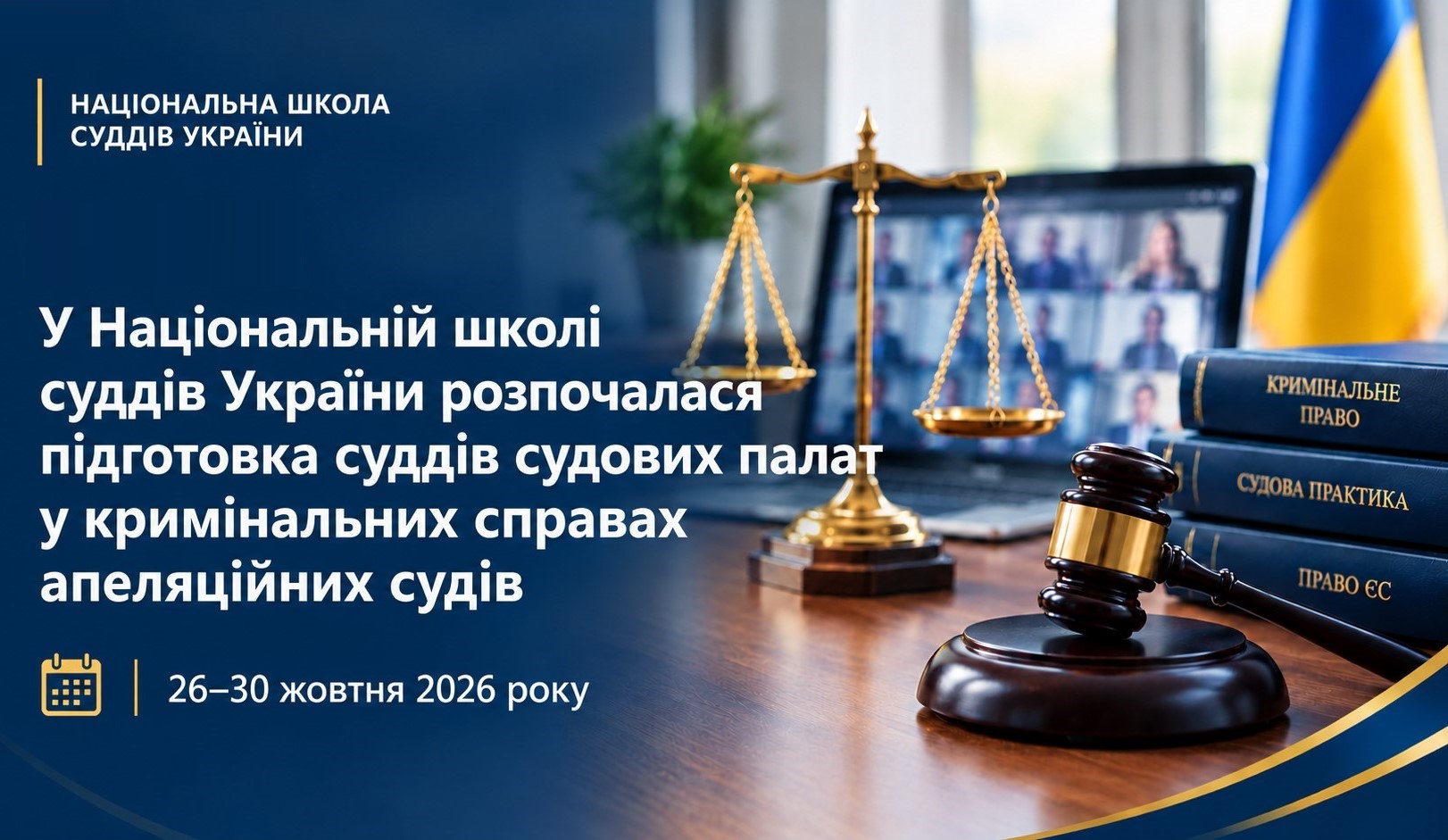
From the assessment of evidence obtained under martial law and the hearing of cases in absentia to the application of international humanitarian law and electronic evidence – these topical issues in criminal justice are covered by a week-long training programme organised by the National School of Judges of Ukraine to maintain the professional competence of judges sitting in the criminal divisions of the courts of appeal.
The programme is designed to deepen judges’ professional knowledge in the field of criminal proceedings, the application of national and international law, and the adoption of modern approaches to the administration of justice.
At the opening of the training programme, the participants were addressed by the President of the Criminal Cassation Court within the Supreme Court, Oleksandr Marchuk, and the Head of the Judges’ Training Department at the National School of Judges of Ukraine, Ivan Balaklytskyi.
The first day of the training is devoted to the principle of the rule of law in criminal proceedings, the specific features of court proceedings in special criminal proceedings in absentia, the application of neuropsychological research in the context of judicial decision-making, and the assessment of evidence obtained under martial law. These topics will be presented by Mykola Mazur, a judge of the Grand Chamber of the Supreme Court; Andrii Masliuk, Deputy Head of the Department for Scientific and Methodological Support of Judges’ Psychological Training at NSJU; and Serhii Fomin, a judge of the Supreme Court in the Criminal Court of Cassation.
The training session ‘Current judicial practice in the examination of criminal proceedings concerning torture’ will take place on 27 October. The event will be moderated by Yelyzaveta Kovtiuk – course director, lecturer-coordinator of the Department for the Training of Lecturers (Trainers) at NSJU, and retired judge of the Supreme Court of Ukraine.
On October 28, participants will examine the architecture of European Union law, the powers of the appellate court following the consideration of an appeal in criminal proceedings, and issues relating to conditional release from serving a sentence on the basis of a plea agreement in cases involving corruption offences. They will also examine the application of international humanitarian law by Ukrainian courts when classifying offences and assessing evidence.
29 October will feature an introduction to the structure and jurisdiction of the Court of Justice of the European Union, current and prospective regulations on the confiscation of property and its various forms, as well as a review of the case law of the European Court of Human Rights in cases against Ukraine for the years 2025–2026 from a criminal law perspective.
The final day, 30 October, will be devoted to a training session entitled ‘Electronic Evidence in Criminal Proceedings’, which will also be moderated by Yelyzaveta Kovtiuk. Following the conclusion of the training, participants will summarise the outcomes and provide feedback on the programme.
The training involves judges from the Supreme Court and courts of appeal, academics, representatives of international projects, and specialists in the fields of law and psychology.
The training is designed to help judges update their professional knowledge, exchange experiences and improve their approaches to the conduct of criminal proceedings, taking into account national legislation, Ukraine’s international obligations and the practice of European judicial institutions.
 Вища кваліфікаційна комісія суддів України
 Сайт Президента України
 Верховна Рада України
 Урядовий портал
 Судова влада України
 Вища рада правосуддя