From an ECHR ruling to a specific court case: how European standards are put into practice in Ukrainian courts
How do European human rights standards apply in actual civil cases in Ukraine? The National School of Judges of Ukraine sought to answer this question together with judges from the Supreme Court and an expert from the Council of Europe during a seminar entitled ‘The Application of ECHR Standards in Civil Cases and the Challenges of Their Implementation’ held in Lviv, combining the practice of the ECHR, the Supreme Court’s current legal positions and the challenges faced by judges in local courts of first instance and courts of appeal when hearing civil cases.
It was precisely the interconnection between the case law of the ECHR and that of the Supreme Court in the adjudication of civil cases that formed the central theme of the discussion. Participants examined the ECHR’s current approaches in cases against Ukraine, their reflection and further development in national judicial practice, as well as the specific features of applying the Convention’s standards in the field of property rights protection.
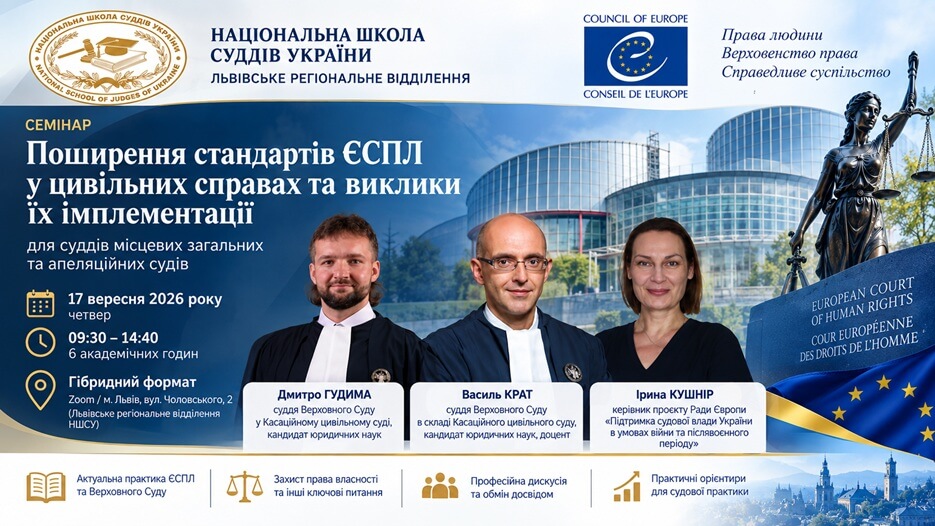
The participants were addressed by Supreme Court judges Vasyl Krat and Dmytro Gudyma, who sit on the Civil Court of Cassation, as well as Iryna Kushnir, head of the Council of Europe’s project ‘Support for the Ukrainian Judiciary during the War and in the Post-War Period’.
Opening the seminar, Oksana Polna, Director of the Lviv Regional Branch of NSJU, emphasised the importance of professional dialogue on the application of ECHR standards in the national judicial system. According to her, such training events provide an opportunity to discuss Convention-based approaches directly in the context of current judicial practice and the challenges judges face when hearing cases.
A distinctive feature of the seminar was its comprehensive view of European standards – not as a collection of individual judgments, but as an interconnected system of approaches that evolves through the interaction between national judicial practice and the practice of the ECHR. Participants traced how legal guidelines are formed during the adjudication of cases by national courts, are further developed in the practice of the Supreme Court, and, in certain cases, become the subject of assessment by the ECHR from the perspective of compliance with the Convention.
Vasyl Krat invited participants to examine the ‘philosophy’ of the ECHR as reflected in the practice of the Civil Court of Cassation – not merely through specific legal positions, but primarily through the Convention-based principles and approaches that underpin them and influence the development of national judicial practice.
Iryna Kushnir presented an overview of the ECHR’s current case law in cases against Ukraine for the years 2025–2026, focusing on judgments and approaches that are relevant to the application of national law.
A separate section was devoted to the protection of property rights. In particular, Dmytro Gudyma elaborated on the relevant approaches of the European Court of Human Rights using the example of land disputes, combining the standards of the Convention with practical issues arising during the judicial consideration of this category of cases.
The combination of the experience of Supreme Court judges and the expertise of the Council of Europe enabled participants to summarise current approaches and outline professional guidelines for the adjudication of civil cases. The discussion also focused on the interrelationship between national practice and ECHR standards, as well as complex and contentious issues regarding their implementation and practical application.
An important part of the seminar was the question-and-answer sessions and the moderated discussion. Direct professional dialogue with the lecturers gave participants the opportunity not only to familiarise themselves with current practice, but also to discuss the rationale behind the development of specific legal approaches, ask questions and relate the guidelines developed to situations arising in day-to-day judicial practice.
This training format helps to ensure that the standards of the European Court of Human Rights remain not only guidelines enshrined in the decisions of the international court, but also a practical tool for ensuring effective civil proceedings in Ukraine that are consistent with the Convention.
 Вища кваліфікаційна комісія суддів України
 Сайт Президента України
 Верховна Рада України
 Урядовий портал
 Судова влада України
 Вища рада правосуддя