From the Constitution and the ECHR to artificial intelligence: a week-long training course for administrative court judges at NSJU
Administrative justice today covers some of the most sensitive categories of disputes for society – ranging from pension and social welfare issues to disputes concerning military and public service. At the same time, European integration, the development of digital technologies and the current case law of ECHR are shaping new requirements for the work of administrative courts.
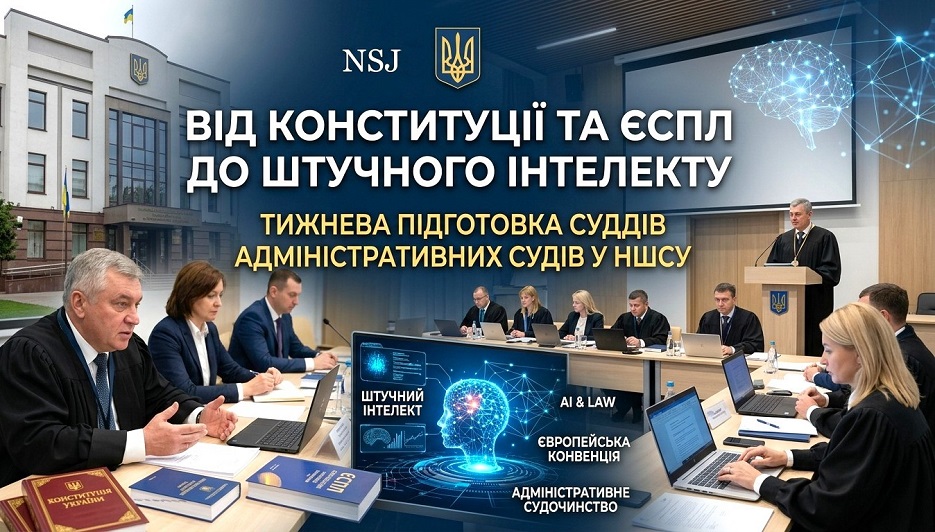
It is precisely these challenges and the practical aspects of addressing them that are the focus of the week-long training programme for judges of district administrative courts and assistant judges of district and appeal administrative courts, organised by the National School of Judges of Ukraine.
The training week comprises four days of lectures and one training session under a separate programme entitled ‘Forms of Administrative Justice’, which will take place on 23 September.
The training programme was opened with welcoming remarks by the Rector of the National School of Judges of Ukraine, Mykola Onishchuk, and the President of the Administrative Court of Cassation within the Supreme Court, Ihor Dashutin.
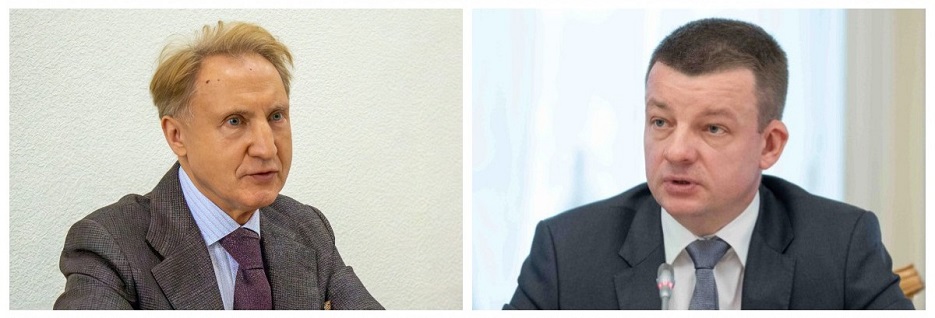
A team of expert judges and specialists has been brought in to deliver the training. The trainers include Supreme Court judges Albert Yezerov, Anna Buchyk, Volodymyr Kravchuk, Ihor Olender, Andrii Zhuk, Volodymyr Bevzenko, Volodymyr Sokolov and Serhii Ukhanenko, Senior Research Fellow at the Department for the Training of Lecturers (Trainers) at NSJU, philologist Oksana Kabysh, Deputy Head of the Department for Scientific and Methodological Support of Judges’ Psychological Training at NSJU, Doctor of Psychological Sciences Andrii Masliuk, international expert and judge at the Court of Justice of the European Union from 2016 to 2023, Doctor of Law Virgilijus Valančius, Iryna Kushnir, project manager of the Council of Europe’s ‘Support for the Ukrainian Judiciary during the War and in the Post-War Period’ project; Oleh Anisimov, judge at the Chernivtsi District Administrative Court; Larysa Trofimova, presiding judge at the Cherkasy District Administrative Court; Volodymyr Horbalinskyi, Head of the Dnipropetrovsk District Administrative Court; and Vasyl Ilkov, a judge at the same court.
The programme covers a wide range of issues directly related to current administrative justice practice. Participants are examining the application of the Constitution of Ukraine, language requirements for court decisions, topical issues concerning the adjudication of pension and social disputes, as well as specific public law disputes relating to military service.
A separate module is devoted to the application of the European Convention on Human Rights and the case law of the European Court of Human Rights (ECHR) in the adjudication of administrative cases. Participants will be introduced to an overview of ECHR judgments handed down since the beginning of 2025, and will also discuss the limits of judicial discretion from the perspective of the ECHR’s case law.
The European dimension of the course continues with an examination of the architecture of European Union law, and the structure and jurisdiction of the Court of Justice of the European Union. The programme also covers the binding nature of court decisions as a principle of administrative justice, and the specific features of the relationship between general and special administrative procedures.
The practical component of the programme covers topical issues relating to taxation, foreign exchange regulation and control, judicial oversight of the enforcement of court decisions in administrative cases, time limits for bringing proceedings in cases concerning public service, as well as judges’ freedom of expression and the use of social media.
Issues relating to the professional competence of judges have not been overlooked either. Participants will explore approaches to preventing professional burnout, as well as the practical aspects of using artificial intelligence technologies.
A separate training session on choosing the form of administrative proceedings
On 23 September, as part of the training week, a training session entitled ‘Forms of Administrative Proceedings’ will take place under a separate programme. The trainers are Diana Gnap, a judge at the Seventh Administrative Court of Appeal; Anna Lebedieva, a judge at the Odesa District Administrative Court; Pavlo Salo, a judge at the Eighth Administrative Court of Appeal; and Maryna Semenenko, a judge at the Second Administrative Court of Appeal.
Participants will examine the general characteristics of types of administrative proceedings and the importance of selecting the appropriate one; the procedural steps and decisions taken by a judge when accepting a statement of claim; the specific features of case consideration under ordinary proceedings; key issues and criteria for selecting simplified proceedings; as well as the specific aspects of handling complex and urgent cases.
The combination of lectures with thematic training provides an opportunity not only to systematise current legal approaches but also to practise applying them in real-world situations. During the course, participants will have the opportunity to discuss challenging issues with the trainers, exchange professional views and relate the knowledge gained to their own judicial practice.
Upon successful completion of the course, participants will receive a certificate from the National School of Judges of Ukraine, attesting to their participation in the system of continuous professional development and their commitment to improving the quality of the administration of justice.
 Вища кваліфікаційна комісія суддів України
 Сайт Президента України
 Верховна Рада України
 Урядовий портал
 Судова влада України
 Вища рада правосуддя