How is commercial litigation changing under the influence of European standards and modern technologies?
Current case law of the Supreme Court and the ECHR, the application of EU law, the use of artificial intelligence and new approaches to drafting court decisions – these issues require judges to constantly update their knowledge and practical skills. It was precisely this combination of modern legal approaches with practical tools for the administration of justice that formed the focus of a five-day training course for judges of local commercial courts, organised by the National School of Judges of Ukraine from 5 to 9 October 2026.
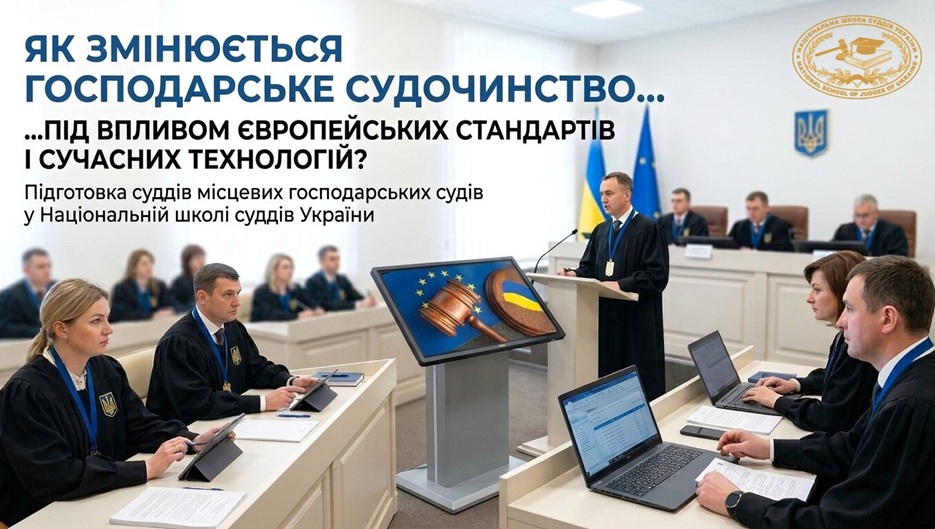
The training programme was opened by the Vice-Rector of the National School of Judges of Ukraine, Nataliia Shuklina, and the Secretary of the Judicial Chamber of the Supreme Court at the Commercial Court of Cassation, Oleh Vaskovskyi. They emphasised the priority of implementing European standards of justice and modern technologies into the day-to-day work of commercial courts. The event was moderated by the Director of the Odesa Regional Branch of the National School of Judges, Volodymyr Pyrohovskyi.
The first day of the training was devoted to the fundamental principles of justice and current issues in commercial litigation. Halyna Yurovska, a judge of the Constitutional Court of Ukraine, spoke about the specific features of applying the legal positions of the Constitutional Court of Ukraine when considering commercial disputes.
Olena Malieieva, a judge at the Commercial Court of Ivano-Frankivsk Region, provided an update on new trends and current practice in the field of contractual obligations within commercial proceedings. In turn, Oleksandr Banasko, a judge of the Grand Chamber of the Supreme Court, focused on the rule of law as the basis for the administration of justice and current judicial practice in bankruptcy cases.
European standards and the integration of EU law into national judicial proceedings were another key area of the training. This topic was explored by Olha Balatska, a judge at the Rivne City Court in Rivne Region, who familiarised participants with the architecture of European Union law, as well as the structure and jurisdiction of the Court of Justice of the European Union.
Particular attention was paid to the digital transformation of the justice system. In particular, Olena Fonova, President of the Commercial Court of Luhansk Oblast, presented on the practical application of artificial intelligence in commercial litigation – one of the pressing challenges facing the modern judiciary.
The European dimension of the training was complemented by a lecture from Taras Rym, a judge at the Western Commercial Court of Appeal, on recent rulings by the European Court of Human Rights in commercial proceedings.
From theoretical foundations, the participants moved on to the practical aspects of drafting judicial decisions. Svitlana Boiko, a judge at the Western Commercial Court of Appeal, outlined contemporary approaches to drafting judicial decisions in commercial proceedings.
A significant part of the programme was devoted to the current practice of the Supreme Court regarding specific categories of commercial disputes. For instance, Anna Vronska, a judge of the Supreme Court in the Commercial Court of Cassation, shared legal perspectives on the adjudication of corporate disputes, whilst her colleague Nadiia Bahai highlighted the specific features of adjudicating disputes arising from contracts for the privatisation of state and municipal property.
The issue of liability for improper performance of commercial obligations was addressed by Oleksandr Kryzhnyi, a judge at the Northern Commercial Court of Appeal.
The lectures were accompanied by question-and-answer sessions, which enabled participants to discuss complex issues of law application directly with the lecturers and to exchange professional experience.
The training was followed by two practical sessions moderated by Volodymyr Polishchuk, lecturer-coordinator of the Department for the Training of Lecturers (Trainers) at the National School of Judicial Service, and Yuliia Blinova, deputy head of the department.
During the training session ‘Judicial Review. Modern Mechanisms and Practice’, the judges deepened their practical skills in applying mechanisms of judicial review and discussed problematic issues arising in judicial practice. The training session ‘Consideration of Appeals against Orders for Provisional Measures (Current Practice)’ was devoted to modern approaches to dealing with this category of procedural issues.
The five-day training programme combined current legal positions, European experience and practical exercises, giving the judges the opportunity to deepen their knowledge of commercial procedure and discuss approaches to the application of legal provisions in complex cases.
In the concluding session, participants shared their impressions of the training, praising the work of the trainers, the structure of the programme, the relevance of the topics, the innovative content and the variety of ways in which the material was presented.
 Вища кваліфікаційна комісія суддів України
 Сайт Президента України
 Верховна Рада України
 Урядовий портал
 Судова влада України
 Вища рада правосуддя