Human trafficking: is Ukraine ready for stricter EU standards?
On 4 March 2026, a coordination meeting was held in Kyiv between representatives of state institutions, international organisations and non-governmental organisations to discuss the implementation of point ‘(e) Human trafficking’ of Cluster 1 of the Roadmap on the Rule of Law. The event was organised by the Programme Office of the United Nations Office on Drugs and Crime in Ukraine.
As is known, on 14 May 2025, the Cabinet of Ministers of Ukraine approved the Roadmap on the Rule of Law. Cluster 1, point “e) Human trafficking” envisages the achievement of a strategic outcome – ensuring an effective mechanism at the state level to prevent human trafficking, aimed at improving the efficiency of identifying perpetrators of human trafficking offences, as well as protecting the rights of victims and providing them with assistance. The document also sets out tasks for achieving full compliance with the EU acquis, in particular the provisions of Directive 2011/36/EU of 5 April 2011 and Directive 2024/1712 of 13 June 2024.
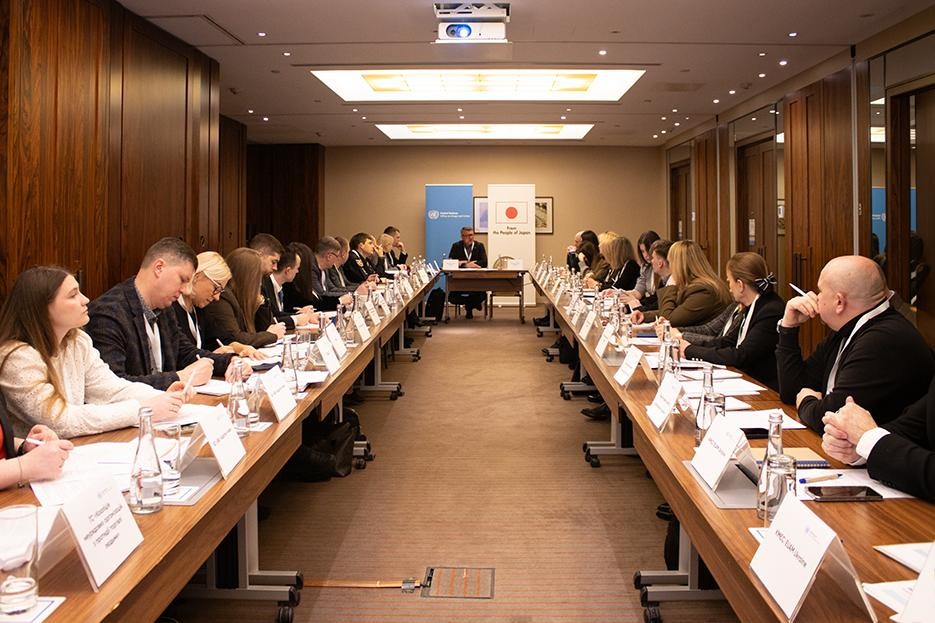
Accordingly, the aim of the meeting was to discuss the current status of the implementation of these provisions, to refine future cooperation plans, to strengthen coordination and ensure sustained inter-agency cooperation, as well as to enhance the effectiveness of the work of specialists involved in the prevention and combating of human trafficking.
Representing the National School of Judges of Ukraine at the event were Natalia Akhtyrska, Head of the Training Laboratory for the Study of European Union Law, and Oksana Mazur, Coordinator of the NSJU course “Combating Human Trafficking in the Context of Armed Conflict”, Oksana Mazur, a leading research fellow in the Department of Research on Judicial Issues and Scientific and Methodological Support for Judicial Education. In her address, Natalia Akhtyrska noted that the course examines issues relating to the implementation of EU law, particularly regarding the principle of the inevitability of punishment for perpetrators and the proper protection of victims of human trafficking.
The representative of the NSJU noted that the implementation of the relevant provisions of EU directives would contribute to improving the effectiveness of justice. In particular, Ukraine must take the necessary legislative and other measures to prevent the risks of child trafficking in the context of surrogacy, which may be regarded as a form of human trafficking under certain circumstances. In a number of countries, surrogacy is prohibited or significantly restricted (France, Germany, Austria, Italy, Sweden, Bulgaria, Iceland, Switzerland, Malta) due to the risks of the commercialisation of childbirth and the potential exploitation of women. It was also emphasised that the definition of “exploitation” (Article 149 of the Criminal Code of Ukraine) should be supplemented with provisions regarding illegal adoption and specific forms of abuse associated with surrogacy.

Natalia Akhtyrska paid particular attention to the need to develop a coherent policy to address the demand that fuels human trafficking. This specifically concerns the possibility of criminalising the use of the services of a person who is a victim of human trafficking, provided that the user is aware of the fact of their exploitation.
The coordination meeting highlighted the importance of consolidating the efforts of state bodies and partner institutions to achieve full compliance with EU standards in the field of combating human trafficking. The systematic implementation of EU directives, the improvement of legislation and the enhancement of professional training for judges and specialists will contribute to strengthening human rights protection mechanisms, effectively bringing perpetrators to justice and shaping a comprehensive state policy in this area.
 Вища кваліфікаційна комісія суддів України
 Сайт Президента України
 Верховна Рада України
 Урядовий портал
 Судова влада України
 Вища рада правосуддя