Not just settling disputes, but helping to resolve them: the NSJU is fostering a culture of alternative dispute resolution
Is a court ruling always the only way to resolve a conflict? The modern justice system is increasingly giving the parties the opportunity to reach an agreement before a dispute turns into a protracted court case. That is why alternative dispute resolution methods are becoming an important complement to traditional court proceedings.
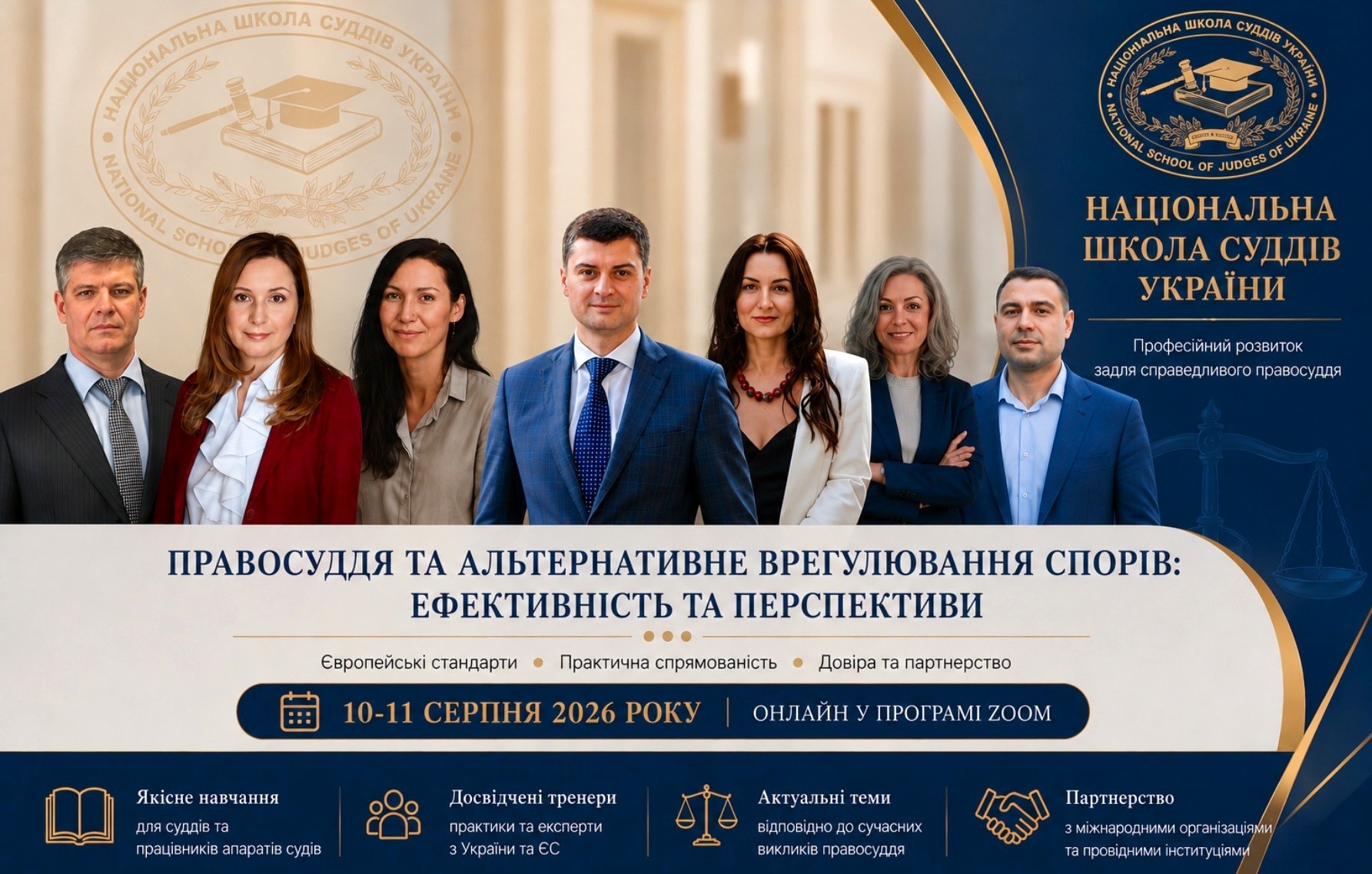
The National School of Judges of Ukraine, in collaboration with the NGO ‘Association of Family Mediators of Ukraine’, organised a two-day training course for judges of local and appeal courts dedicated to this issue.
The training focused on European standards of justice, alternative dispute resolution (ADR), mediation, judge-facilitated dispute resolution and other modern tools that enable the parties to reach a mutually acceptable solution. After all, modern justice is not just about determining who is right and who is wrong. In many cases, it is important to create conditions under which the parties can listen to one another, see the possibility for compromise and make their own decision that takes their interests into account.
It was precisely this approach that the training participants explored, not only in theory but also in practice. The judges analysed the principles and possibilities for applying alternative dispute resolution (ADR) in accordance with national legislation and international standards, identified the categories of disputes in which mediation might be most effective, and practised ways of properly informing the parties about the possibility of an amicable settlement.
A separate module of the training was devoted to dispute resolution involving a judge. Participants explored the specific features of this procedure, simulated practical scenarios and worked on effective models of communication with the parties.
Another key objective was to strike a balance between traditional court proceedings and alternative dispute resolution methods. Participants discussed when alternative mechanisms might be most appropriate and how their use could enhance the effectiveness of the justice system. The intensive programme combined short lectures, practical exercises, group work, case studies and professional discussions.
The training session was attended by experts in the fields of law, justice and mediation: Viktoriia Antonova, judge at the Commercial Court of Kyiv Region; Vasyl Ilkov, judge at the Dnipropetrovsk District Administrative Court, Doctor of Laws, Professor, LL.M; Ella Kataieva, judge at the Odesa District Administrative Court; Vadym Kulebiakin, a judge at the Chemerovetskyi District Court of Khmelnytskyi Region; Olha Shmindruk, a mediator, member of the NGO ‘Association of Family Mediators of Ukraine’ and barrister; and Anzhela Krychyna, a mediator, attorney, and member of the supervisory board of the NGO ‘Association of Family Mediators of Ukraine’.
The training session was moderated by Maksym Khodakivskyi, a judge at the Sobornyi District Court of Dnipro, a lecturer at the National School of Judges of Ukraine, Doctor of Philosophy in Law, LLM in Mediation, and Iryna Fedorych, a mediator, Chair of the Board of the NGO ‘Association of Family Mediators of Ukraine’, co-author and trainer of professional policies and training programmes on mediation, and visiting lecturer at the School of Law of the Ukrainian Catholic University.
As the speakers at the training session emphasised, mediation and dispute resolution involving a judge are not an alternative to justice, but a modern complement to it. Their development makes it possible to reduce the duration and cost of disputes, alleviate emotional tension between the parties, and create the conditions for reaching a solution formulated directly by the parties to the conflict.
For the judicial system, this does not mean abandoning traditional judicial proceedings, but rather expanding the range of tools available to judges to ensure the effective protection of human rights and interests and to find the most appropriate way to resolve a dispute.
The development of a culture of dialogue, reconciliation and a responsible approach to conflict resolution is an important component of modern Ukrainian justice, which is actively promoted by the National School of Judges of Ukraine.
 Вища кваліфікаційна комісія суддів України
 Сайт Президента України
 Верховна Рада України
 Урядовий портал
 Судова влада України
 Вища рада правосуддя