NSJU develops a five-year strategy for the training of judges in EU law
How should judicial training change to ensure that Ukrainian judges are prepared to apply European Union law and work in the context of Ukraine’s future EU membership? The National School of Judges of Ukraine is working on this issue together with international and national experts. On 17 September 2026, the National School of Judges of Ukraine hosted the second meeting of the Advisory Council of Experts at the Training Laboratory for the Study of European Union Law.
The meeting was a continuation of the Council’s work, which began in June this year, and was dedicated to one of the Training Laboratory’s key areas of activity – the development of a strategic vision for the advancement of judicial education in the field of EU law in Ukraine.
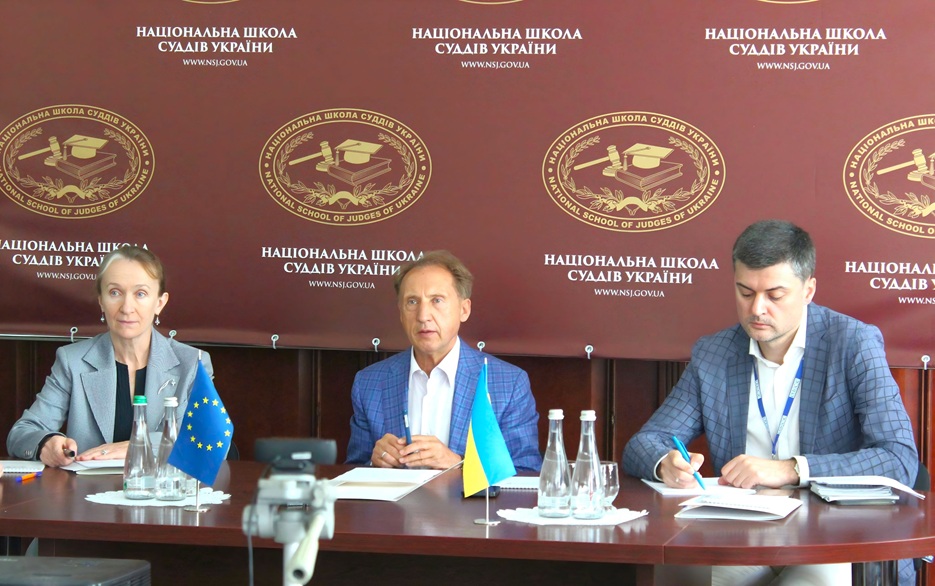
Opening the meeting, the Rector of the National School of Judges of Ukraine, Mykola Onishchuk, emphasised that Ukraine’s acquisition of EU candidate status had significantly accelerated the implementation of the tasks set out in the Association Agreement, particularly with regard to judges’ study of EU law.
According to him, the training of judges is one of the key components of fulfilling European integration objectives. It should contribute to the development of judicial competence, digital skills and knowledge of European law, with a particular focus on the rule of law and fundamental rights, as well as their practical application in the day-to-day work of the courts.
That is why, as Mykola Onishchuk noted, with a view to comprehensively implementing the tasks set out in the Rule of Law Roadmap and the National Programme for the Adaptation of Legislation to EU Standards by 2030, it is advisable to develop and adopt a Strategy for the Training of Ukrainian Judges in EU Law for the period up to 2030.
The aim of the Strategy should be to establish a modern system of continuing education for Ukrainian judges in the field of EU law, which will ensure the judiciary is prepared for Ukraine’s functioning as a Member State of the European Union.
The Rector also emphasised that the development of the Strategy fulfils one of the recommendations made by the NSJU following the results of the TAIEX audit conducted in 2025.
The Advisory Council was joined by a judge of the Court of Justice of the European Union from 2016 to 2023, Dr Virgilijus Valančius, Doctor of Laws; Fryderyk Zoll, Professor at Jagiellonian University and the University of Osnabrück; John Morijn, Professor of Law and Politics at the University of Groningen; Olesia Radyshevska, a judge of the Supreme Court at the Administrative Court of Cassation; Tetiana Komarova and Tetiana Anakina, professors and lecturers at the Yaroslav Mudryi National Law University; Nataliia Akhtyrska, a professor at Taras Shevchenko National University of Kyiv; Maksym Khodakivskyi, a judge at the Sobornyi District Court of Dnipro, and staff members of the Training Laboratory for the Study of EU Law.
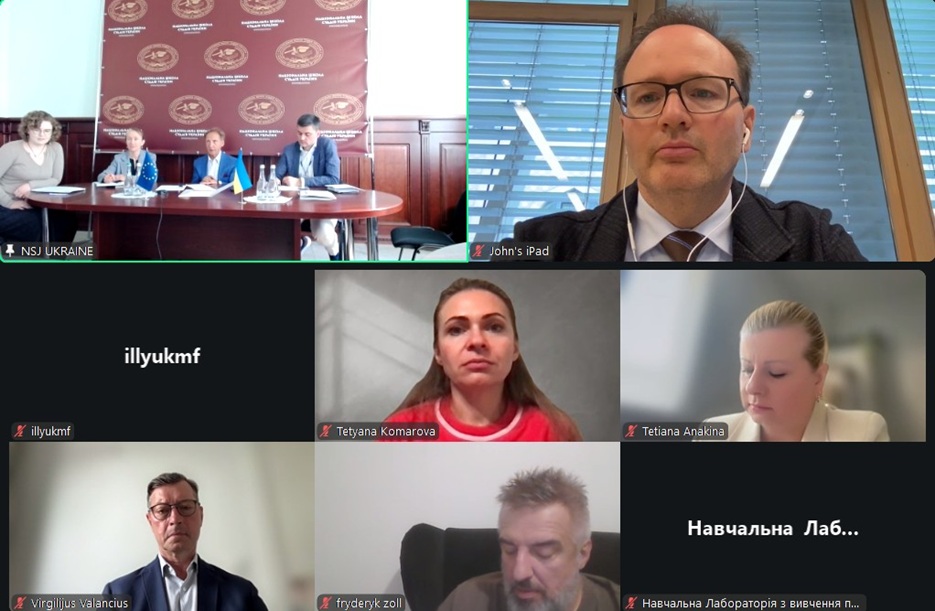
The draft Strategy was presented by Nataliia Akhtyrska. She outlined its main provisions, objectives and priority areas for the development of training for judges in EU law. It was specifically noted that, in accordance with the European Commission’s recommendation, at least 65% of Ukrainian judges should undertake courses on EU law each year.
During the expert discussion, members of the Advisory Council made proposals and recommendations regarding the draft document. Participants discussed approaches to identifying priority areas for training, the content of educational programmes, the development of professional competences among judges and other representatives of the justice system, as well as mechanisms for the practical implementation of the Strategy.
The experts paid particular attention to ensuring that training in EU law is not limited to theoretical knowledge. They emphasised the need to equip judges with practical skills in applying EU law, as well as an understanding of the legal positions of the Court of Justice of the European Union and their significance for national judicial practice.
An important part of the discussion was the examination of European experience in judicial training, in particular the practices of states that joined the European Union during the 2004–2007 enlargement. Such experience makes it possible to identify effective approaches to preparing judges in candidate countries for the full application of EU law.
Separately, the participants emphasised the need for further international expert cooperation and the involvement of European partners in implementing strategic objectives in the field of judicial education.
Following the meeting, it was agreed to continue refining the draft Strategy, taking into account the proposals and recommendations of the Advisory Council members. It was also decided to approach the ‘PravoJustice4EU’ project with a request to provide an independent expert opinion on the document.
The approaches developed by the experts are intended to contribute to the creation of a comprehensive model for the training of judges in EU law, which will meet the current needs of the Ukrainian justice system and the challenges associated with Ukraine’s European integration.
The work of the Advisory Council of Experts is an important component of the activities of the NSJU Training Laboratory for the Study of European Union Law. Involving international experts, representatives of the judiciary and the academic community in its work makes it possible to combine European experience, judicial practice and academic expertise for the systematic development of training for Ukrainian judges in the application of EU law.
 Вища кваліфікаційна комісія суддів України
 Сайт Президента України
 Верховна Рада України
 Урядовий портал
 Судова влада України
 Вища рада правосуддя